
Prompt Engineering Essentials
Prompt engineering is the skill of writing clear, precise instructions that guide an AI toward higher-quality, relevant responses. The wording of your prompt directly affects the accuracy, depth, and usefulness of what you get back. In short, the old computing principle applies: garbage in, garbage out.
Whether you use AI to summarize materials, generate study questions, or refine research ideas, your ability to ask the right questions shapes the quality of the response.
How AI Generates Responses
Before writing better prompts, it helps to recall what happens when AI reads your input. As Module 1 covered, a large language model does not "understand" your words; it predicts likely text based on patterns in its training data. The short video below from MIT Sloan's Rama Ramakrishnan reviews how ChatGPT and other LLMs generate responses.
The 5 Core Parts of a Prompt
To build an effective prompt, consider these components:
- Directive: the main instruction that tells the AI what to do.
- Examples: sample inputs or outputs that guide the response.
- Role (persona): a perspective or expertise you assign to the AI.
- Output format: how the response should be structured (list, table, paragraph).
- Additional information: context that makes the answer more accurate.
Example: Improving a Prompt
Weak prompt
What's missing? No context, audience, examples, or output format. The AI could return anything from one sentence to a research paper.

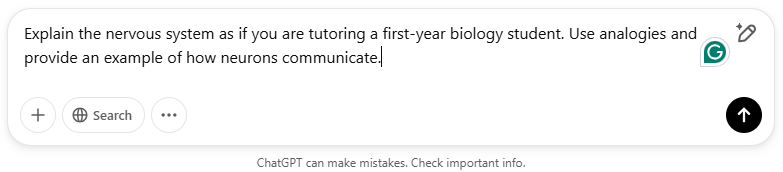
Better prompt
Why is this better? It gives a clear directive, assigns a role ("tutoring a first-year biology student"), adds context, and asks for specific examples ("use analogies," "an example of how neurons communicate"). The result is more relevant and structured.
The CLEAR Framework
The five core parts help you build a strong first request; the CLEAR framework helps you refine it. It was developed by Dr. Leo S. Lo of the University of New Mexico to make AI-generated content more effective and relevant:
- Concise: remove unnecessary detail and keep the request specific.
- Logical: if your prompt has several parts, structure them so the AI sees how they relate.
- Explicit: state the format, content, or scope you want.
- Adaptive: adjust your prompt based on what the AI returned.
- Reflective: keep evaluating your prompts and the responses to improve over time.
For a deeper dive, see Dr. Lo's article, "The CLEAR path: A framework for enhancing information literacy through prompt engineering," available through (YOUR LIBRARY).
Prompting Strategies
These techniques are written for ChatGPT but also apply to other models, including Claude, Gemini, and open-source LLMs.
- Be clear and specific.
- Use step-by-step instructions for complex tasks.
- Assign the AI a role or persona.
- Ask for explanations, not just answers.
- Experiment with wording to refine the output.
- Put your most important instructions first and last; models can lose track of details buried in the middle of a long prompt.
- Give the AI your own source material (a reading, your notes, your data) and tell it to answer from that, which improves accuracy and cuts down on made-up details. Only do this when AI is permitted for the assignment, and only with material you are allowed to share, never paste copyrighted or sensitive content into a tool that is not approved for your account.
- Match your approach to the model: newer reasoning models (the o-series, DeepSeek R1, Gemini's thinking models) mainly need a clear problem statement, while standard models benefit from more examples and structure.
The "Act As" technique asks the AI to take on a role, which can sharpen its responses. For example:
- "Act as a travel agent and recommend destinations based on my budget and interests."
- "Act as a JavaScript console. I will type commands, and you provide the output."
- "Act as a job interviewer. Ask me questions for a software engineering position, one at a time."
- Overloading with too much information: keep prompts focused.
- Vague or open-ended wording: set clear expectations.
- Ignoring the AI's limits: be realistic about what it can do.
- Skipping format instructions: specify list, table, paragraph, and so on.
- Unclear or irrelevant response? Reword for clarity.
- Too generic? Add context or specify the depth you want.
- AI not following instructions? Break the request into smaller steps.
- Getting repetitive? Reset the chat and rephrase.
The Future of Prompt Engineering: Problems, Not Just Prompts
As AI advances, the emphasis is shifting from fine-tuning prompts to defining well-structured problems for AI to help solve. Some experts, like Smith (2023), predict AI will increasingly generate its own prompts. Others, like Acar (2023), argue the most valuable skill is writing precise problem statements that guide AI toward meaningful solutions.
That shift is already visible in newer reasoning models, such as OpenAI's o-series and DeepSeek R1, which work through problems step by step on their own. With these models, piling on "think step by step" instructions or many examples can actually make results worse; what helps is stating the problem clearly and giving the model room to reason. A related shift is the rise of AI agents, which carry out multi-step tasks for you, so the skill becomes describing a goal and the constraints around it, not scripting every step.
However AI evolves, the ability to define clear, well-structured problems will remain essential. By practicing both prompt engineering and problem formulation, you will be ready to work with AI tools now and as they change.
Beyond the Frameworks: Focus on the Task, Not the Tricks
Frameworks like CLEAR (and others you may run across, such as RISEN, CRAFT, or CARE) are useful scaffolding when you are starting out. But a growing view in 2026 is that they matter less than they appear. One popular shortcut is meta-prompting: asking the AI to write or refine a prompt for you ("Here is my goal and my draft prompt; how would you make it clearer?"). It can help, but it can also backfire.
The lesson for your own work: your real value is understanding a task well enough to describe it clearly in your own words. Frameworks can get you moving, but once you can lay out how the task is actually done, step by step, you rarely need the acronyms. That is good news, because it means the most important skill is not a secret syntax; it is knowing your subject and thinking clearly about it.
This is also why understanding your discipline matters. Experts get strong results not because they know clever prompting tricks, but because they can spell out the method their field actually uses, and they can tell when the AI gets it wrong. A history student might walk the AI through how they read a primary source: who created it, when, and why, then corroborate it against other evidence. A nursing student might lay out a clinical-reasoning sequence; a law student might apply the IRAC structure (Issue, Rule, Application, Conclusion); a literature student might describe how they move from theme to textual evidence to interpretation. The clearer your grasp of how your field thinks, the better you can guide an AI tool, and the faster you can catch its mistakes.
Good Sources In, Better Results Out
Generative AI is trained largely on text that was publicly available on the internet, which ranges from excellent to unreliable. The model blends it all into fluent, plausible-sounding answers, with no built-in sense of which sources were trustworthy. That is why what you bring to the conversation matters: when you ground your work in high-quality, vetted sources, your results are far more likely to be accurate and defensible.
This is where (YOUR LIBRARY) is a real advantage. The library gives you access to peer-reviewed articles, scholarly books, and curated databases that chatbots were not reliably trained on, plus librarians who can help you build search strategies, evaluate sources, and apply the research methods specific to your field. Better inputs lead to better, better-grounded outputs.
More on this, written for libraries: "Academia, AI, and Over the Garden Wall" and "Can Use of AI Impact Ownership and Citations in Academic Work?", Ask the Lawyer, Western New York Library Resources Council (WNYLRC), 2026.
Knowledge Check
Select an answer to see feedback. Each option explains why it is or is not correct.
Question 1 of 5
Why does clear, specific wording matter when you prompt an AI?
Question 2 of 5
Which set best describes core parts of a strong prompt?
Question 3 of 5
Newer "reasoning" models (such as the o-series or DeepSeek R1) change how we prompt because they:
Question 4 of 5
What matters most for getting good results from an AI tool?
Question 5 of 5
You want a chatbot to help you summarize a PDF chapter from a library database. What is the safest move?
Additional Resources on Prompts
As LLMs evolve, new prompting techniques keep emerging. Alongside the resources below, your library can point you to more.
- prompts.chat – a curated collection of prompts for various AI platforms.
- Caulfield, M. (2026, April 27). You can just say how to do things: A radical approach to expert prompting. Mike's Substack.
- Korzyński, P., Mazurek, G., Krzypkowska, P., & Kurasiński, A. (2023). Artificial intelligence prompt engineering as a new digital competence. Entrepreneurial Business and Economics Review, 11(3), 25–38.
- Bozkurt, A. (2024). Tell me your prompts and I will make them true: The alchemy of prompt engineering and generative AI. Open Praxis, 16(2), 111–118.
- (YOUR LIBRARY) catalog: Prompts and Artificial Intelligence – explore books, articles, and more.