What Is Artificial Intelligence (AI)?
Artificial intelligence is the development of computer systems that can perform tasks usually associated with human intelligence: interpreting language, recognizing patterns in large datasets, making decisions, and perceiving the world through images or sound.
An early definition: in a 1955 proposal for the Dartmouth Summer Research Project, held in 1956, John McCarthy and colleagues coined the term "artificial intelligence" and described it as making a machine "behave in ways that would be called intelligent if a human were so behaving." That proposal set the agenda for decades of research.
A Brief History of AI
Although AI is often associated with recent technology, its origins trace back to the mid-twentieth century. After the 1956 Dartmouth conference, researchers focused on systems that could solve problems and reason through logic.
Over the following decades, AI moved from simple rule-based systems to techniques like machine learning and deep learning. These advances let AI take on harder tasks, from playing chess (as when IBM's Deep Blue defeated Garry Kasparov in 1997) to powering navigation apps and language translation. The timeline below highlights selected moments in that history.
AI in Everyday Life
As AI has developed, it has been built into many everyday tools, often working behind the scenes:
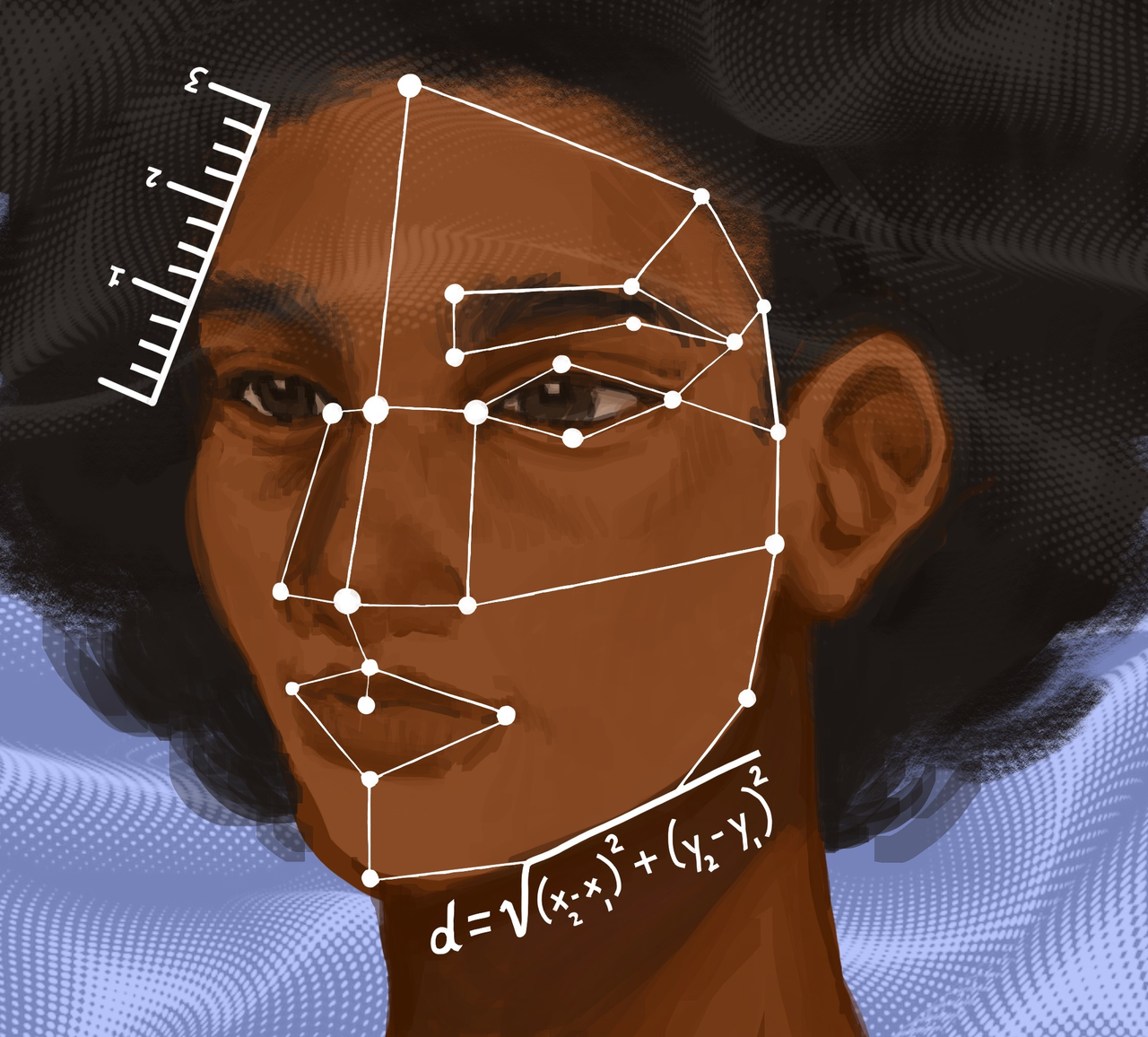
- Unlocking smartphones with facial recognition.
- Navigating with apps like Google Maps or Waze to find faster routes.
- Detecting fraud in your bank account using anomaly detection.
- Recommending music, films, or products based on your preferences.
- Translating text between languages with tools like Google Translate.
- Voice-to-text and assistants like Siri, Alexa, or Google Assistant.
- Writing support from grammar tools like Grammarly.
- Conversational chatbots like ChatGPT or Microsoft Copilot that draft text and answer questions.
From AI to Machine Learning
Now that we have seen how AI shows up in daily life, let us look at how these systems actually learn. AI covers a wide range of technologies, including natural language processing, speech recognition, computer vision, and neural networks. Two subfields are worth understanding:
- Machine Learning (ML): a subset of AI that lets computers learn from data without being explicitly programmed. ML algorithms find patterns and make decisions based on data.
- Deep Learning (DL): a specialized form of ML that uses neural networks with many layers to process complex data like images, speech, and text.
These terms are often used interchangeably, but they nest inside one another: deep learning is a kind of machine learning, which is a kind of AI. Select each layer to see what it means and an example.
Select Artificial Intelligence, Machine Learning, or Deep Learning above.
How Machine Learning Works
Unlike traditional programming, where computers follow step-by-step instructions, machine learning lets computers learn from experience. Much as people improve through trial and error, ML systems get better over time by analyzing more data. Every time you scroll a social media feed, ask a voice assistant for help, or get a personalized recommendation, machine learning is working behind the scenes.
Key Data Processing Approaches
AI processes data, identifies patterns, and makes decisions based on those patterns. There are two main approaches to how a model learns:
Supervised Learning
A model learns from labeled data, where each input has a known correct output: an image of apples labeled "apples," or an e-mail marked as "spam." Recognizing patterns in these examples helps the model make predictions for new data. It is commonly used for classification tasks such as speech recognition, medical diagnosis, and e-mail filtering.
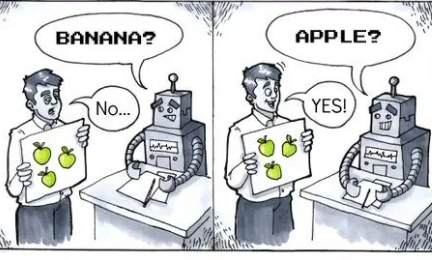 Illustration by Ciaraioch. Used with permission.
Unsupervised Learning
A model works with unlabeled data, identifying patterns without predefined categories, such as grouping customers by shopping habits. Instead of predicting a specific outcome, it clusters similar data or detects hidden relationships. It is useful for market segmentation, trend analysis, and anomaly detection in large datasets.
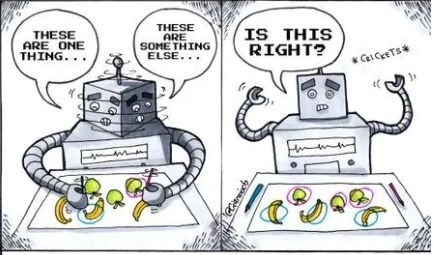 Illustration by Ciaraioch. Used with permission.
Try It: Train a Model
Same six pieces of fruit, two very different jobs. Switch between the tabs to feel the difference between learning with labels and learning without them.
This is a simplified illustration, not a real model being trained.
How Neural Networks Work
Neural networks are inspired by the structure of the human brain, where billions of neurons process information and recognize patterns. In artificial neural networks (ANNs), these neurons are recreated in software to handle tasks like image recognition, language translation, and recommendations. Each neuron receives inputs, processes them through simple math, and passes outputs to the next layer, letting the network learn and improve over time.
Knowledge Check
Select an answer to see feedback. Each option explains why it is or is not correct.
Question 1 of 4
Which of the following was an early milestone in AI history?
Question 2 of 4
Which event was a landmark moment showing AI could outperform top human experts at a complex strategic game?
Question 3 of 4
Which AI technology is modeled on the brain's structure, using software "neurons" to process information and recognize patterns?
Question 4 of 4
Which learning approach involves AI identifying patterns in unlabeled data?
Key Takeaways
- AI mimics human intelligence but learns from patterns in data, not from lived experience.
- Machine learning lets AI recognize patterns and improve its performance over time.
- Deep learning uses neural networks for complex tasks like image and speech recognition.
- AI is embedded in everyday life through voice assistants, recommendations, and automation.
- AI is not intelligent the way humans are: it lacks emotions, consciousness, and the ability to understand as people do.